Specifications
Grading & Market Data
Estimated Value
Valuation data is not yet available for this type. We publish estimates only when they can be derived from recorded auction results.
Coin Design
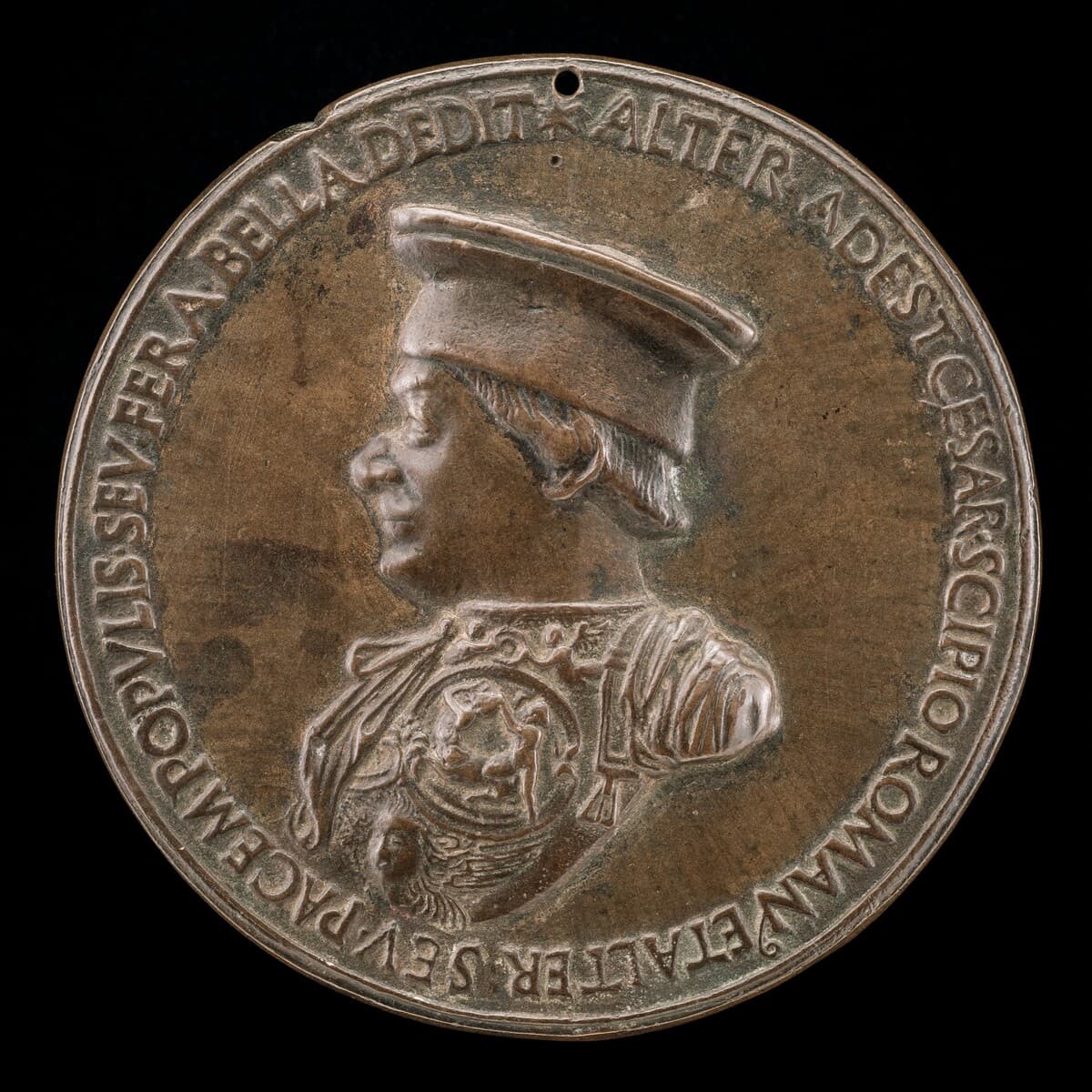
Federico da Montefeltro facing left, wearing decorated all’antica armour and a mortier
Three stars with astronomical symbols; below an eagle holding a horizontal beam on his outstretched wings, one side of which is occupied by a Roman cuirass, a shield decorated with the head of a Gorgon and a sword, and the opposite by an olive branch and a brush; in the center a massive sphere/globe
Overview
A characterful Bronze coin with rich patina bringing the medieval world vividly to life. Its distinctive surface character, acquired over centuries, adds authentic beauty. Minted circa 1468, issued in Roman Empire, under Federico da Montefeltro, classified as a Condottieri Medals 79, this coin provides an invaluable window into the political, economic, and cultural conditions of its era. The obverse features "Federico da Montefeltro facing left, wearing decorated all’antica armour and a m," demonstrating extraordinary die-engraving skill. The reverse depicts "Three stars with astronomical symbols; below an eagle holding a horizontal beam ," conveying powerful cultural symbolism. Medieval coinage reflects a period when faith and power were inextricably linked. Rebuilt after the fall of the Roman Empire through Carolingian reforms, each hand-struck medieval coin possesses unique character. The Crusades facilitated unprecedented exchange between Eastern and Western monetary traditions, creating fascinating hybrid designs prized by modern collectors. Medieval minting continued the hammered tradition while introducing important advances in standardization and quality control. Assay masters monitored fineness at each mint, and the Islamic world developed distinctive calligraphic coin designs. Late medieval innovations including early screw presses enabled more uniform striking, foreshadowing the mechanized revolution to come. Medieval coins mirrored the cultural values of both Christendom and the Islamic world. European designs featuring crosses and saints reflected faith's centrality, while Islamic coins developed distinctive calligraphic traditions within the prohibition on figural imagery. These coins document the dialogue and conflict between civilizations. Roman and Italian coins are among the most actively traded in the global numismatic market. Imperial gold aurei and silver denarii command premium prices at Heritage Auctions, CNG, and NAC. An ideal entry point for medieval coinage collecting. Authentication begins with precise measurement of weight, diameter, and thickness against published specifications. Die engraving style, serif forms, and letter spacing should be compared with known genuine specimens. XRF analysis provides non-destructive verification of metallic composition. For high-value coins, third-party certification by PCGS or NGC is strongly recommended, as certified coins benefit from guaranteed authenticity and enhanced market liquidity. Proper environmental management is essential for long-term coin preservation. Storage areas should maintain 18-22°C temperature and 40-50% relative humidity, avoiding sudden fluctuations. Use only archival-quality, acid-free coin holders, flips, or capsules—never PVC-containing materials, which cause irreversible green contamination. Always handle coins wearing cotton or nitrile gloves, holding by edges only, as fingerprint oils react with metals causing permanent damage. Cleaning is generally discouraged: improper washing destroys natural patina and significantly reduces market value. Consult a professional conservator if cleaning appears necessary. Numismatic collecting offers both intellectual enrichment and asset preservation potential. Over the past fifty years, rare coin markets have demonstrated long-term returns comparable to equities and gold, with particular resilience during inflationary periods. However, successful coin investment requires expertise in grading, provenance assessment, rarity evaluation, and market trend analysis. PCGS/NGC-certified coins offer superior liquidity through major auction houses and dealer networks worldwide. Even for investment-focused collectors, choosing coins that personally appeal ensures sustained motivation for long-term holding. A systematic, theme-based approach to collecting is recommended—whether by chronology, geography, or denomination. A 'quality over quantity' philosophy has proven most effective for long-term value preservation. Keywords: medieval, coin, numismatic, collectible, bronze, Roman Empire, auction, investment, grading, rare coins, antique coins.
Find This coin
Our expert concierge will find the coin for you.