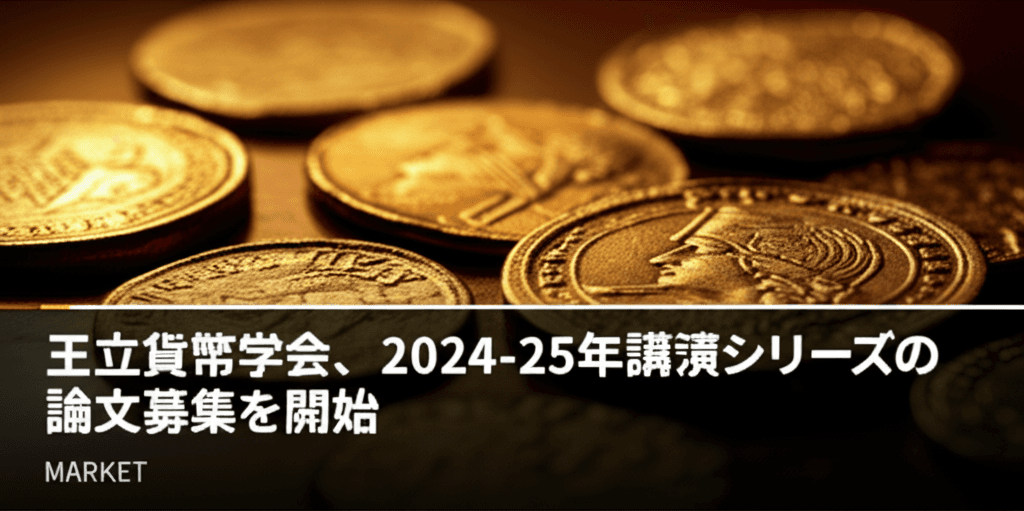
RNS 2024-25 Lecture Series: How Academic Authority Protects Rare Coin Market Integrity
Market

RNS 2024-25 Lecture Series: How Academic Authority Protects Rare Coin Market Integrity

Verdict:Conclusion: Academic provenance verification via RNS-standard institutions is non-negotiable before rare coin purchases; skip it at authentication peril.
Summary

The Royal Numismatic Society's 2024-25 Call for Papers reaffirms its role as the academic backbone of rare coin authentication and provenance verification.The Royal Numismatic Society (RNS), the UK’s foremost society for numismatics, offers lectures and publications dealing with various currency items, supporting diversity in numismatic research among scholars and enthusiasts from around the world.

The Royal Numismatic Society (RNS) has established itself as the preeminent academic institution for numismatic scholarship in the United Kingdom and increasingly on the global stage. Since its foundation in 1836 as The Numismatic Society of London, the RNS has continuously advanced the study of coins, medals, and related currency items across all historical periods and geographical regions. This nearly two-century tradition has allowed the society to accumulate unparalleled expertise and build an extensive network of scholars, collectors, and museum professionals dedicated to numismatic research.

The evolution of RNS from a London-based organization to an internationally recognized academic body reflects broader changes in numismatic scholarship. Today, its membership comprises researchers from leading universities, major museums, and private research institutions across Europe, Asia, North America, Africa, and beyond. This global composition ensures that the society's research agenda encompasses diverse monetary traditions and cultural perspectives, from ancient Mediterranean civilizations to contemporary numismatic systems. The international character of RNS membership strengthens the intellectual rigor and comprehensiveness of the organization's scholarly output.

The current Call for Papers for the 2024-25 lecture series represents a significant initiative to consolidate and advance numismatic knowledge. This call welcomes submissions from established scholars and emerging researchers alike, providing a prestigious platform for presenting original research to an international audience of specialists. The broad scope of eligible topics—encompassing historical analysis, technical studies, conservation methodologies, cataloging approaches, and cultural interpretations—demonstrates the multifaceted nature of contemporary numismatic inquiry.

Numismatic research carries profound historical and cultural significance beyond the immediate interests of collectors. Coins and medals function as primary historical documents, bearing witness to political systems, economic structures, artistic values, and social hierarchies of their respective periods. The inscriptions, portraits, and symbolic imagery on ancient and medieval coins provide crucial evidence for understanding historical figures, dynastic relationships, religious beliefs, and trade networks. Similarly, analysis of coin circulation patterns and metallurgical composition reveals information about economic exchange systems, technological capabilities, and cultural interactions that might otherwise remain obscure.

The contemporary ancient coins market has experienced substantial growth over the past decade, with auction prices for rare and historically significant pieces reaching record levels. This market expansion reflects both increasing collector interest and growing recognition of numismatic items as legitimate investment assets. However, maintaining market integrity and transparency requires rigorous academic standards, including expert authentication, chronological determination, provenance verification, and comparative analysis. The scholarly work produced by institutions like RNS provides the authoritative foundation upon which market confidence and ethical practice depend.

For serious collectors, participation in or attendance at RNS lecture series offers direct access to cutting-edge research and expert knowledge that significantly enhances collecting strategies and collection appreciation. The interaction between academic researchers and private collectors generates reciprocal benefits: collectors gain deeper understanding of their holdings and acquisition decisions, while scholars gain access to significant private collections that contribute to broader research initiatives. This mutually beneficial relationship has proven essential to the advancement of numismatic knowledge.

The anticipated research topics for the 2024-25 series span an impressive temporal and geographical range.Classical, Asian, Medieval, and Modern coins, paper money, tokens, medals, and related currency items all represent fertile areas for scholarly investigation. Thematic diversity in accepted papers will likely include political numismatics, economic history through monetary systems, artistic and iconographic analysis, and numismatic responses to cultural and religious developments.

Conservation and preservation research constitutes another critical dimension of contemporary numismatic scholarship. The development and refinement of conservation techniques, corrosion prevention methodologies, and scientific analytical approaches have practical applications for institutions and collectors at all levels. Advanced technologies including digital imaging, X-radiography, isotopic analysis, and spectroscopic methods are increasingly integrated into numismatic research, yielding insights into manufacturing techniques, material provenance, and historical usage patterns that traditional methods cannot provide.

Database development and standardized cataloging systems represent increasingly important research areas in numismatic studies. Major museums and repositories managing collections exceeding several million objects require sophisticated information management systems. Academic research into optimal cataloging methodologies, data structure standards, and digital accessibility protocols provides essential guidance for institutions worldwide, facilitating research collaboration and knowledge exchange across institutional boundaries.

The cultural and symbolic significance of numismatic imagery has emerged as a dynamic field of scholarly investigation. National and regional monetary systems embody collective identity, historical memory, political ideology, and cultural values through their carefully selected iconography and symbolic representations. Research examining how new states select foundational symbols for their currencies, how political transitions alter monetary design, and how numismatic imagery reflects social and cultural transformations contributes valuable perspectives to historical, political, and cultural studies.

Prospective contributors to the RNS call should recognize the importance of original scholarly perspective, rigorous documentation using primary and secondary sources, logical argumentation grounded in evidence, and strict adherence to academic integrity standards. Acceptance by an international academic body requires contributions that advance existing knowledge rather than merely presenting interesting discoveries. Proper citation of illustrative materials and reference sources significantly strengthens submissions.

The trajectory of numismatic scholarship points toward increasing internationalization and interdisciplinary integration. Incorporating insights from economics, anthropology, art history, materials science, and digital technologies will enrich numismatic inquiry and establish connections to broader academic conversations. The RNS 2024-25 lecture series represents a significant platform for articulating this expanded vision of numismatic scholarship and facilitating collaborative research across traditional disciplinary boundaries.

Related Articles

LINE Subscription

Weekly Market Intelligence

Weekly rare coin intelligence — auctions, price action, and analysis, delivered via LINE.

Free · Instant · Block anytime