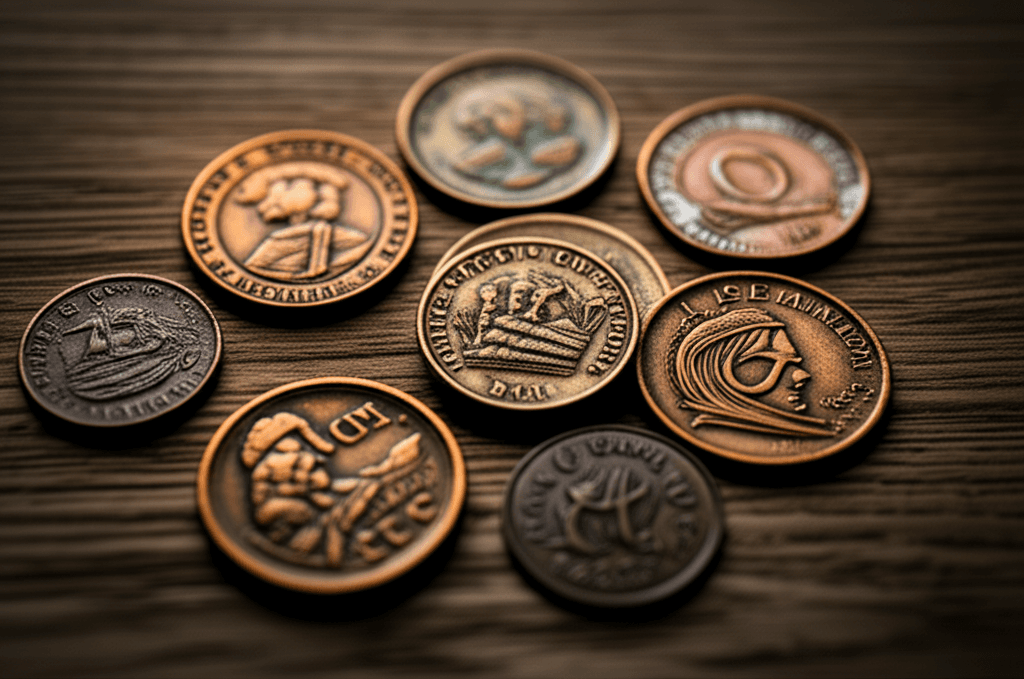
Collectors Exchange Coins in Informal Networks
An account of a private transfer of a numismatic collection between two friends reveals the importance of informal networks, provenance, and shared knowledge that exist beyond official market transactions.
A story about a collector receiving old coins from a friend has sparked discussion as an example of direct transactions between collectors.
The Unofficial Transfer Network Among Collectors Existing Outside the Market
Transactions in old coins typically occur in markets or at auction. However, these are not the only venues. An informal network also exists, through which collectors exchange items based on personal connections.
Recently, one individual's experience drew attention. They described how a chance reunion with an old friend led to an offer to acquire part of his collection.
In these kinds of direct exchanges, it is not just the items that are passed on, but also the provenance and knowledge associated with them. This exchange of value, different from what occurs in a market transaction, has become a topic of conversation among collectors.
More Than Just Investment Value: The Bonds Collectors Form Over Decades
Many voices in the community agree that collecting old coins is about more than just investment or asset value. Collectors meet at exhibitions, antique fairs, and online gatherings, forming strong bonds through their shared hobby. Among local enthusiasts in particular, it is not uncommon for these relationships to last for decades. In this context, old coins become special items that tell a story of a person's life and their relationships with others.
Former Colleagues Reconnect After 15 Years Over a Shared Interest in Numismatics
One collector shared a story about reuniting with an old friend, a former colleague from a previous workplace. They met again after 15 years at a local event organized by a mutual friend.
At first, they simply reminisced about old times. But as they talked, they discovered a surprising common interest: they both collected old coins. This coincidence, he said, was the catalyst for renewing their friendship.
Collector B's Motivation: A Systematic Collection for Understanding Local History
The collecting philosophy of one regional collector, referred to as B, has been a subject of discussion. B lives in the regional city where he used to work and began collecting old coins 15 years ago. His motivation was a desire to deeply understand the history of his own region.His interest focused particularly on the history of coins, and he wanted to experience that history through the coins themselves. As a result, B's collection is not merely an assortment of rarities. It is systematically organized and preserved as a set of specimens that tell the story of Japan's economic history.
From the Need to Downsize to the Decision to Entrust a Collection to a Fellow Enthusiast
One collector shared the background of why he decided to part with a portion of his collection. As he entered a new stage in life, he was faced with the need to organize his physical possessions. However, this was a collection he had lovingly built over many years. He wanted to entrust it to someone who shared his passion, not treat it as a disposable item. The story goes that reconnecting with an acquaintance gave him the perfect opportunity to fulfill this wish.
Rare Kan'ei Tsūhō Coins Transferred Along with the Previous Owner's Detailed Research Notes
A collector's post about a collection he received from another enthusiast has generated interest. The collection consisted of various old coins, including Kan'ei Tsūhō from the Edo period. It drew particular attention for including rare varieties produced at regional mints and pieces whose year of manufacture is difficult to determine.
Also passed on was a set of detailed notes created by the previous owner. This notebook documented the acquisition history of each coin, its estimated date, and changes in its state of preservation. It also contained the previous owner's own discoveries and thoughts from the collecting process.
The Minting Period of a Kan'ei Tsūhō: B's Research, Overturning Common Theory, is Passed Down
The story of a transfer between two collectors is gaining notice. When collector A received old coins from collector B, the transfer included not just the catalog value of the items, but B's personal research as well.
One example given was the minting period of a certain Kan'ei Tsūhō coin. By comparing multiple examples of the same type and cross-referencing them with historical documents, B had identified a more accurate date than the one commonly accepted.
Because this knowledge was passed on with the coin, A inherited not just the physical object, but also the fruits of B's research and his thought process.
Value Not Reflected in Market Prices: The Story of a Coin's Provenance and Storage
A post by a collector, B, has been a topic of discussion in the community. He points out that when you buy an item at auction or in an antiques market, the information you get is limited. It mostly consists of basic data: the year, the mint, an estimated rarity, and a general grade. However, the old coins he received directly came with their provenance—a story of when and where they were acquired and the environment in which they were stored. While many collectors find great value in this kind of background, it is not something directly reflected in market prices.
More Than Just Coins: The Care Taken to Transfer the Entire Preservation Environment, Including Containers and Desiccants
The details of a handover between two collectors have become a talking point in the community. The story described how it wasn't just the coins that were transferred, but the entire preservation environment.
According to the post, the storage containers, desiccants, and even temperature management records used by the original owner were all passed along. This was done out of concern that a sudden change in the long-term storage environment could damage the collection. The poster explained that an abrupt shift in humidity, in particular, can cause metal to oxidize and diminish its value.
This meticulous exchange has been praised as something that could only happen in a private transfer based on a relationship of trust.
Edo and Kamakura: A Mutual Exchange of Expertise Between Collectors A and B
By receiving old coins from B, collector A gained a new perspective on his collecting activities. A's original interest was in coins from the Kamakura and Muromachi periods. However, through B's collection, he deepened his understanding of the Edo-period economic system and regional variations in currency. This was not a one-way exchange. Through email correspondence with A, B also gained knowledge about Kamakura-period coins that he had previously overlooked. The incident has been noted as a case where not just physical objects, but also specialized knowledge, were mutually exchanged.
A and B's Research Notes Lead to Solving a Local Numismatic Mystery
An interesting development occurred within a regional community of old coin enthusiasts, sparked by the interaction between two collectors, A and B. At a small exhibition they organized, a portion of the transferred collection was displayed. What particularly captured the attendees' attention were the detailed research notes created by B. These notes became the basis for a discussion that, with the cooperation of the participants, led to solving a long-standing mystery surrounding several local coins. One individual's activities ended up deepening the knowledge of the entire community.
More Reliable Than Any Certificate: The Long-Standing Trust That Functions Between Collectors
One exchange has highlighted the value of direct transactions between collectors. The official market has various rules in place to protect buyers. However, some point out that these regulations can also create distance between the buyer and seller. In contrast, when collectors exchange items directly, there may be no contracts or certificates of authenticity. In these cases, a relationship of trust built over many years functions as the ultimate guarantee. One person's dedication to a collection is carefully passed on to the next. Some argue that this relationship is more reliable than any single piece of paper.
Coins Passed Through Many Hands: A Provenance That Records the Lives and Relationships of Their Owners
A post from a collector who received a collection from an acquaintance has been attracting attention.
According to the post, this transfer was a significant turning point for him. Old coins are passed down through many hands over the long years since their creation. He stated that this event marks a new step in that history.
This post suggests that the provenance of old coins is not simply a record of an object's movement, but is deeply intertwined with the lives and relationships of its owners.
Collector A Publishes Acquired Information Online, Aiding Future Generations of Numismatists
Examples like that of A and B, where a collection is received from a senior collector, are drawing attention. This is more than just acquiring an item; it is a form of inheritance where the knowledge behind it is passed on as well. A is now publishing the provenance and information about the collection he received online. This record of his activities serves as a guide for those new to numismatics, helping them learn about the historical context.
"Use for Research, Share the Knowledge": The Transfer of Coins as a Cultural Asset
The exchange of old coins between A and B has been a topic of discussion in one community. This was not a transaction through the market, but a transfer based on a personal relationship.
The two had a clear agreement: the coins received would be used for research and exhibition. It was also agreed that any knowledge gained from them would be shared with the community.
This was more than a simple transfer of ownership. It seems there was a mutual understanding regarding the responsibility of how to manage the collection and how to contribute to society. Such an exchange demonstrates an attitude of treating old coins as cultural assets with a value beyond the material.
Scanning Handwritten Notes: Preserving Knowledge for the Future Through Digitization
A movement among collectors to digitize the records of acquired coin collections is gaining traction. A and B are reportedly photographing the collection and creating a detailed database. Notably, the handwritten research notebook created by B was also scanned.
The data is said to be stored in multiple locations. This method ensures that the records can be protected even in the event of a fire or natural disaster. It also makes it easier to share the records with others. This can be seen as an attempt to use modern technology to preserve not just the physical coins, but also the knowledge behind them, for the future.
Five Years After the Transfer, A and B's Relationship Deepens into a Joint Publishing Project
A report has been made on the ongoing exchange between two collectors, A and B. Their relationship began with the transfer of the coin collection. Their interaction did not end there and continues to this day.
They regularly exchange opinions via email and phone, sharing newly acquired items and knowledge. B occasionally visits A's collection in person to see its changes and growth. This relationship, which began with a coin transaction, has deepened over five years to the point where they are now planning a small joint publication.
Beyond Market Value: Passing Down Knowledge and Life Stories to the Next Generation
The story of a collector who received a collection from an old friend is a topic of conversation. This event shows that the value of old coins cannot be measured by market valuation and rarity alone.
In market transactions, an old coin is treated simply as an asset. But when collectors pass items to each other face-to-face, something more than a physical object is exchanged. The knowledge of how a particular piece was acquired, the experience gained over years of collecting, and sometimes even the life stories of the owners are passed down to the next generation.
This kind of intangible value can only be created within a network of collectors built on trust. In an age where digital communication is the norm, the importance of meeting and talking in person remains unchanged. As the example of A and B shows, numismatics transcends the scope of a personal hobby. Historical items serve as a medium to connect people, knowledge is shared, and new discoveries are born from it. This cycle is the very essence of the numismatic community.
The Value of Old Coins Beyond Price: How Trust Facilitates the Transfer of Knowledge and Provenance
An instance of an old coin collection being transferred between friends has become a topic of discussion. This story demonstrates that the value of old coins is not determined solely by market appraisal or rarity. When a collection changes hands, it is not just the physical items that are passed on, but also the associated knowledge, experience, and sometimes even the owner's personal story. This kind of value is seldom generated in market transactions, which use price as their primary metric. Private transfers like the one between A and B are only possible because of the trust that exists between collectors.
Why Do Old Coins Bring People Together? The Essence of the Collector Community
This case demonstrates that numismatics is an activity that goes beyond being a mere personal hobby. Historical items act as a medium, connecting one person to another. Within these connections, knowledge is shared, and new discoveries can emerge. Even in an era where digital interaction is mainstream, the importance of face-to-face communication and relationships built on trust remains unchanged. This circulation of people and knowledge is one of the essential values of the collector community.
A Condensed Textbook on Modern Economic History: The Social Significance of a Numismatic Collection
The transfer of old coins between two collectors has become a talking point in the community. This event was perceived not simply as a transfer of assets, but as something with broader significance.
The collection received consists of coins from different periods. These are seen as "witnesses of material culture" that reflect the economic conditions of the era in which they were issued. In other words, the collection as a whole can serve as a condensed textbook on Japan's economic history. B believes that through these items, students can gain an experiential understanding of Japan's modernization.
The transfer process has also drawn attention as an example of knowledge being passed down across generations. The interaction between A and B can be said to show a new form of learning that is not a one-way transmission. Some have commented that in our modern age of expanding online communication, this incident makes us re-evaluate the educational value that comes from deep, in-person exchanges.
Prioritizing the Next Owner Over Maximizing Profit: The Value of Trust Beyond Formal Authentication
The case of a collector directly transferring his collection to another has been widely discussed. This transaction was reportedly conducted without going through official grading services or auctions, based solely on the trust between the two parties.
The value of old coins is heavily dependent on expert authentication that determines their genuineness and state of preservation. For this reason, personal connections between collectors and a mutual respect for each other's knowledge can carry significant weight in a transaction.
In this case, the individual who transferred the collection appears to have prioritized the next owner's ability to properly manage and utilize it over maximizing financial gain. This decision, which values something that money cannot buy, is being described as a choice unique to the world of numismatics, where expertise and trust intersect.
From Private Collection to Joint Publication: The Scholarly Value Created by Transferring to a Younger Researcher
The transfer of a collection from one collector (A) to a younger researcher (B) has been noted. What makes this story interesting is that the collection is not simply being put into storage. The recipient, B, is collaborating with the original owner, A, to plan a publication related to the collection.
This initiative may allow the scholarly value of privately collected historical materials to be shared with a wider audience. If it takes the form of a publication, specialized knowledge can be disseminated to the general public, potentially broadening interest in the field of numismatics.
Furthermore, when a new generation of researchers like B sheds new light on existing collections, there is an expectation that it will advance the study of numismatics itself. It seems that passing a collection on to the next generation not only preserves a past legacy but also leads to the creation of new knowledge.
Intergenerational Transfer and Digitization: What is the Future of the Collector Community?
This recent event also serves as a catalyst for thinking about the future of the numismatic community.
One topic of discussion is the intergenerational transfer of knowledge. As experienced collectors age, how can their expertise be passed on to the younger generation? There is hope that by successfully addressing this challenge, it will be possible to increase the number of new participants in the field of numismatic research.
The use of digital technology is also a topic. Some point out that the spread of online tools could invigorate interaction between collectors that was previously difficult due to geographical constraints.
However, there is also a strong opinion that no matter what technology is introduced, the value of human relationships mediated by physical objects like old coins will not change. Some voices suggest that in an increasingly digital society, these human connections may, in fact, become even more significant. Perhaps the community of the future will need to balance a flexibility to embrace new generations and technologies with a commitment to cherishing long-held knowledge and personal connections.
Related Articles
Weekly Market Intelligence
Weekly rare coin intelligence — auctions, price action, and analysis, delivered via LINE.
Free · Instant · Block anytime