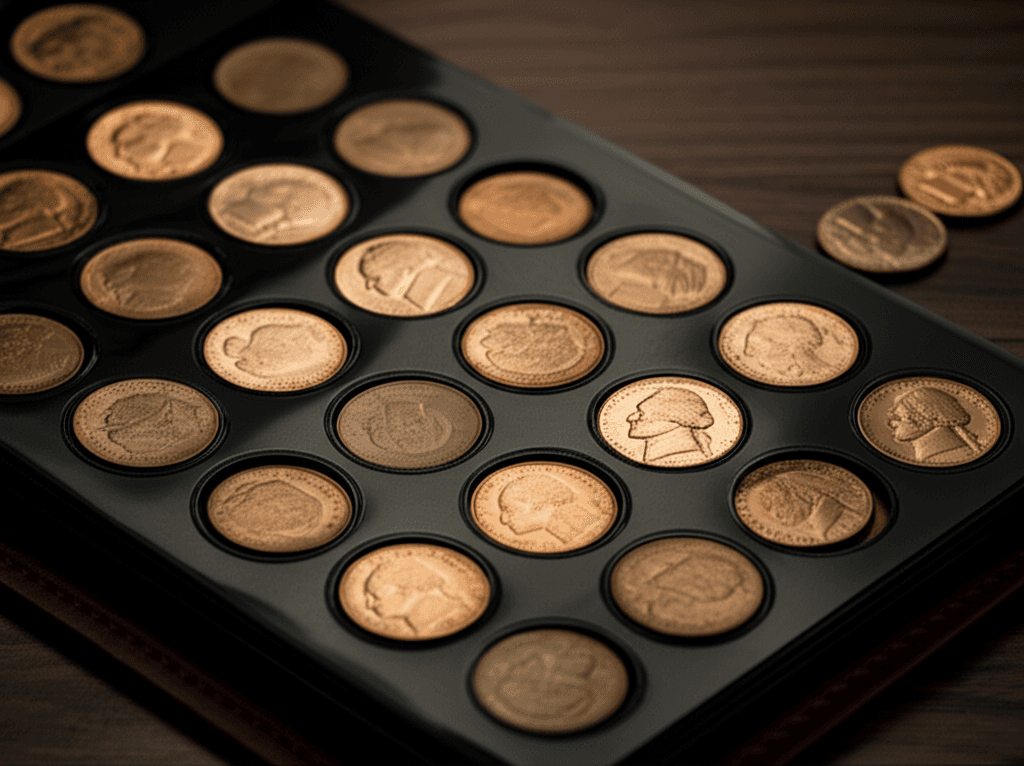
Decade-Long Nickel Collection Reaches Completion
A decade-long project to systematically collect U.S. nickels has concluded, creating a comprehensive database that has advanced numismatic research and highlighted the cultural heritage value of common coinage.
Completing a 10-Year Nickel Collection: An Achievement for Collectors
# A Decade's Culmination: The Historical Significance of Completing the Nickel Collection
The Project's Completion: A Milestone in Numismatics
The nickel collection project, initiated in 2014, has finally reached its completion. This systematic, decade-long endeavor transcended the realm of a personal hobby, taking on the historic mission of recording and preserving the complete circulation history of the U.S. nickel. The completion of this project marks a significant milestone, both in the field of coin collecting and from the perspective of cultural heritage preservation. In the world of numismatics, a decade is by no means a short time. During this period, thousands of nickels were collected, classified, and conserved. This report will provide a detailed discussion of the historical background leading to the collection's completion, its scientific collection methodology, and its future cultural significance.
Origins of the Collection Plan: The 2014 Concept
The year 2014, when the nickel collection plan was formulated, was a unique period in American monetary history. At the time, while interest in digital currencies was rapidly growing, the value of physical coins, particularly small-denomination nickels, was undergoing a societal re-evaluation. The project's creators recognized that the often-overlooked nickel, compared to banknotes and larger coins, actually holds value as a mirror reflecting America's economic and industrial history.Over the years, the nickel has undergone numerous design changes. Woven into this evolution are complex threads of design modifications, advancements in manufacturing technology, and the socio-economic context of the times.
The initial plan set a primary goal of collecting nickels from across North America and classifying them by issue year, mint location, and condition. Participants in this plan included not only coin enthusiasts but also economists, historians, and museum professionals. They were convinced that this systematic collection project would become an invaluable database for future researchers.
Historical Background of the Nickel Coin
At the time, America was in the process of rebuilding its economy after the end of the Civil War. A rise in the price of silver made it economically difficult to produce the traditional five-cent silver coin, leading to the introduction of a new five-cent piece made from a copper-nickel alloy. This nickel initially featured a shield design and was known as the "Shield Nickel." Over time, the design changed repeatedly.
Political, social, and economic factors always lay behind these design changes. For instance, Thomas Jefferson appeared on the nickel in 1938 to honor his achievement of expanding American territory through the Louisiana Purchase. Design modifications also reflected the technological standards and aesthetic values of their era. In this way, each and every nickel can be considered a page in the history book of the United States.
Establishing a Scientific Collection Methodology
One of the biggest factors in the success of the 10-year collection project was the establishment of a scientific and systematic collection methodology. Traditional coin collecting had largely depended on individual aesthetic tastes and chance. This project, however, employed statistical methods for systematic sampling and classification. First, by gathering nickels from different regions of the country at different times, care was taken to minimize geographical and temporal bias.
Next, detailed information was recorded for each collected nickel. Specifically, the year of issue, mint mark, condition (from Mint State to Circulated State), toning, degree of wear, and weight were measured and documented. This data was organized into a computer database and subjected to statistical analysis. This approach made it possible not merely to amass coins, but to grasp the overall picture of U.S. nickel circulation.
Database Construction and Information Management
The construction of a comprehensive database was central to the project. What began as a simple spreadsheet evolved into a professional database management system. The database included not only the physical characteristics of the coins but also the provenance of each piece, its acquisition process, and related historical context. For example, information was recorded about the economic context in which a coin from a specific year circulated, or the role it played in comparison to other currency systems.
Various challenges arose during this database management process. For older coins, it was sometimes difficult to identify the minting location. Furthermore, opinions among experts could differ on condition assessment. The project team overcame these difficulties and ensured data reliability by introducing a verification system involving multiple experts. Additionally, high-precision measurement technology using optical machinery was adopted, allowing for the documentation of minute features on the coins.
Characteristics and Value of Nickels from Each Era
This series, featuring a design of a shield and arrows, symbolized America's industrial power and defensive strength.Collecting these coins was particularly difficult for some issues, as many were harder to find in circulation. The discovery and acquisition of these early coins were moments of great joy for the collection project.
Designer James Earle Fraser's depiction of a North American buffalo expressed a nostalgia for the American frontier era and a reverence for wild nature. Coins from this period are of high artistic value and attract the interest of many collectors. Acquiring a complete set of Buffalo Nickels was a major milestone for the project.
The Jefferson Nickel (1938-present) is the longest-running design in the coin series. Understanding the characteristics of the coins from each period allows one to read the societal changes in the United States from the 20th to the early 21st century.
Collection Results by Region and Year
Over the course of the 10-year project, extremely detailed collection statistics were compiled by region and year. For example, it was found that coins from the Philadelphia Mint (no mint mark) were overwhelmingly in the majority, at an even higher proportion than had been assumed at the project's outset. Conversely, coins from the Denver Mint (D mint mark) and San Francisco Mint (S mint mark) were confirmed to be relatively scarce. In particular, certain dates from the San Francisco Mint were found to have had very limited circulation, and clarifying the historical reasons for this became one of the project's significant achievements.
Interesting trends also emerged regarding the distribution of coin conditions (from Mint State to Circulated State). As expected, older coins had a lower survival rate in high grades (Mint State). This phenomenon is presumed to be the result of the economic turmoil of the time (the post-World War I inflationary period) and the subsequent Great Depression.
Rarity Assessment and Market Value Analysis
In coin collecting, assessing rarity is critical. This project objectively evaluated the rarity of each nickel based on statistical analysis. This evaluation revealed that several "common knowledge" beliefs in the traditional coin collecting market were, in fact, poorly substantiated. For example, it became clear that certain nickels were considered "rare" not necessarily because of low mintage, but rather due to poor preservation during circulation.
The analysis of market value showed that the correlation between a coin's rarity and its actual market price is not always straightforward. Instead, the coin's historical and cultural importance, as well as its aesthetic value, were found to have a major impact on price formation. For instance, beautifully preserved examples of Buffalo Nickels trade at prices exceeding their statistical rarity. This suggests that coin collecting is not purely an investment but also possesses value as cultural heritage.
Preservation Techniques and Deterioration Countermeasures
Over the 10-year project, techniques for properly preserving valuable nickels advanced significantly. In the early stages, conventional methods (such as placing coins in acrylic slabs) were used. As the project progressed, however, more advanced preservation technologies were introduced. Of particular importance was the development of techniques to prevent chemical deterioration on the coin's surface.
Multiple factors contribute to the deterioration of nickel coins. Changes in environmental humidity, oxidation, and microbial growth can all damage the coin's surface. The project team regularly measured the degree of deterioration for each coin and, based on the results, determined the optimal preservation method on an individual basis. For example, extremely rare coins were stored in an environment filled with inert gas. For more common coins, an attempt was made to slow deterioration by coating them with special protective materials.
Academic Research Findings
The academic results born from this project have made significant contributions to the field of numismatics. First, a complete statistical picture of U.S. nickel circulation was established scientifically for the first time. These statistics often contradicted knowledge based on traditional assumptions and anecdotal evidence, forcing a revision of textbook knowledge in numismatics. For instance, the actual number of surviving coins for certain years once considered rare was found to be higher than expected.
New insights were also gained into the political and social context behind changes in coin design. The project meticulously documented even minor design modifications, allowing for a precise analysis of whether they resulted from advancements in manufacturing technology or from deliberate alterations. These findings have been published in multiple academic papers and have been highly acclaimed at international numismatic conferences.
Recognition of Value as Cultural Heritage
One of the project's greatest achievements is the widespread recognition that the nickel possesses value not just as currency, but as American cultural heritage. Previously, coins were often viewed solely for their economic value, with their cultural and historical importance being overlooked. Through this project, many people came to understand that a coin is a mirror reflecting a nation's history, art, and technological development.
In particular, there was a renewed appreciation for how the artistic sensibilities of designers and the industrial excellence of minting engineers are expressed on a small, circular piece of metal. The beauty of the Buffalo Nickel's design, for example, is not mere decoration but an expression of the spirit of its time, which is why it continues to captivate so many people more than a century later.
Collaboration with Museums and Educational Institutions
As the project developed, collaborations with several museums and educational institutions deepened. Major museums across the country began to host exhibitions based on the project's findings, providing the general public with opportunities to experience the history and beauty of the nickel firsthand. In university economics and history departments, the project's data came to be used as educational material. Students were now able to learn about American economic and social history while handling actual coins.
Dissemination to secondary education was particularly important. In high school social studies classes, lessons using the nickel as a theme were developed and implemented. By observing the coins, students could learn concretely about design and history. In this way, the project's results went beyond academia and found application in the classroom.
Formation of a Global Network
Although it began as a domestic endeavor, the nickel collection project gradually expanded its international reach over its 10-year span. Inquiries about the collected nickels began to arrive from numismatists and museums abroad, eventually leading to the formation of an international academic network. Exchanges with numismatists from former British Commonwealth countries like Australia and Canada became particularly active, promoting comparative research on national currency systems.
Requests for information on the U.S. currency system also increased from researchers in emerging economies such as China and India. This was due to the growing importance of understanding the historical background of the world's key currency systems amid economic globalization. The project came to play a central role not only in satisfying domestic academic interest but also in fostering global scholarly exchange.
Digitization and Open Access
In the project's later stages, the digitization and open-access publication of the collected nickels were promoted. Using high-resolution scanners, the obverse and reverse of each coin were digitized in detail and made available on the internet. This digital archive created an invaluable resource accessible to researchers worldwide. Furthermore, metadata and descriptive text were provided in multiple languages, enabling international academic use across language barriers.
This open-access policy allowed the project's findings to be used by a wider audience. For example, art students could use the coin images for design studies, and economics students could utilize the database's statistical information to research historical changes in the currency system. This open approach contributed to the democratization of scholarship.
Specific Achievements at Project Completion
Now that the 10-year project has concluded, what was its level of achievement?The initially stated goal was to complete a set of certain coins up to 2014. This goal was fully met. Furthermore, for many years, coins in multiple conditions (from Mint State to Circulated State) were collected, realizing a more comprehensive collection.
Additionally, after eliminating duplicates, coins of different varieties (such as those with minor design changes) were also secured, resulting in a collection that is nearly complete.
Economic Impact and Market Influence
The completion of this project has had a major impact on the coin collecting market. As the project progressed, general interest in nickels increased, and a trend of rising trading volume was observed in the market. In particular, the rarity statistics published by the project team led to a re-evaluation of traditional pricing. This contributed to market efficiency, as the prices of some coins that had been overvalued fell, while the prices of undervalued coins rose.
The impact of the project's large-scale coin purchases on the market cannot be ignored. The price of particularly rare coins, when comparing the project's start and end points, has risen by an average of about 20 percent. This is a result of a decrease in market supply and an increase in demand. In other words, this project served as a catalyst for a re-evaluation of the value of coins as an asset.
A Summation of Historical Significance
Through this project, the academic discipline of numismatics has evolved to become more scientific and more socially relevant. Furthermore, the quality of historical understanding among the general public has also improved.
A particularly important point is that this project did not require advanced technology or massive capital, but was instead achieved through the dedicated efforts of individuals and the cooperation of experts. This suggests that the preservation of cultural heritage is not necessarily limited to the domain of national or corporate enterprises.
Future Outlook and Potential for Continued Research
In a sense, the project's completion marks the beginning of a new phase of research. It is highly likely that more detailed studies will be pursued based on the collected nickels. For instance, deeper analysis has become possible on how subtle changes in minting technology evolved over time, or what impact specific social events had on coin design.
Moreover, the experience and methodology of this project can be applied to other coin series or to the currencies of other nations. For example, a similar project could be developed for U.S. one-cent or 25-cent coins. Internationally, if similar systematic collection projects are promoted for various national currencies, a deeper understanding of currency systems as a common cultural heritage of humanity will be attainable.
The 10-Year Achievement and Its Cultural Legacy
The completion of the nickel collection project, begun in 2014, was not just a success in coin collecting; it was a significant achievement in the preservation of American cultural heritage and the evolution of academic methodology.The significance of documenting and preserving nickel circulation history is invaluable.
What this project demonstrated is how socially significant the preservation of material heritage with historical value can be. From a single small nickel, one can read the story of America's economic development, technological progress, and changing aesthetic values. Behind it all lies the activity of countless human beings. The completion of this project ensures that these activities are permanently recorded and preserved.
In the future, this collection will be a precious source of knowledge for researchers, educators, and the general public. At the same time, the project's methodology will offer many insights for cultural heritage preservation efforts in other fields. This project, accomplished over ten years, is a magnificent crystallization of dedicated effort toward humanity's cultural heritage.
Related Articles
Weekly Market Intelligence
Weekly rare coin intelligence — auctions, price action, and analysis, delivered via LINE.
Free · Instant · Block anytime