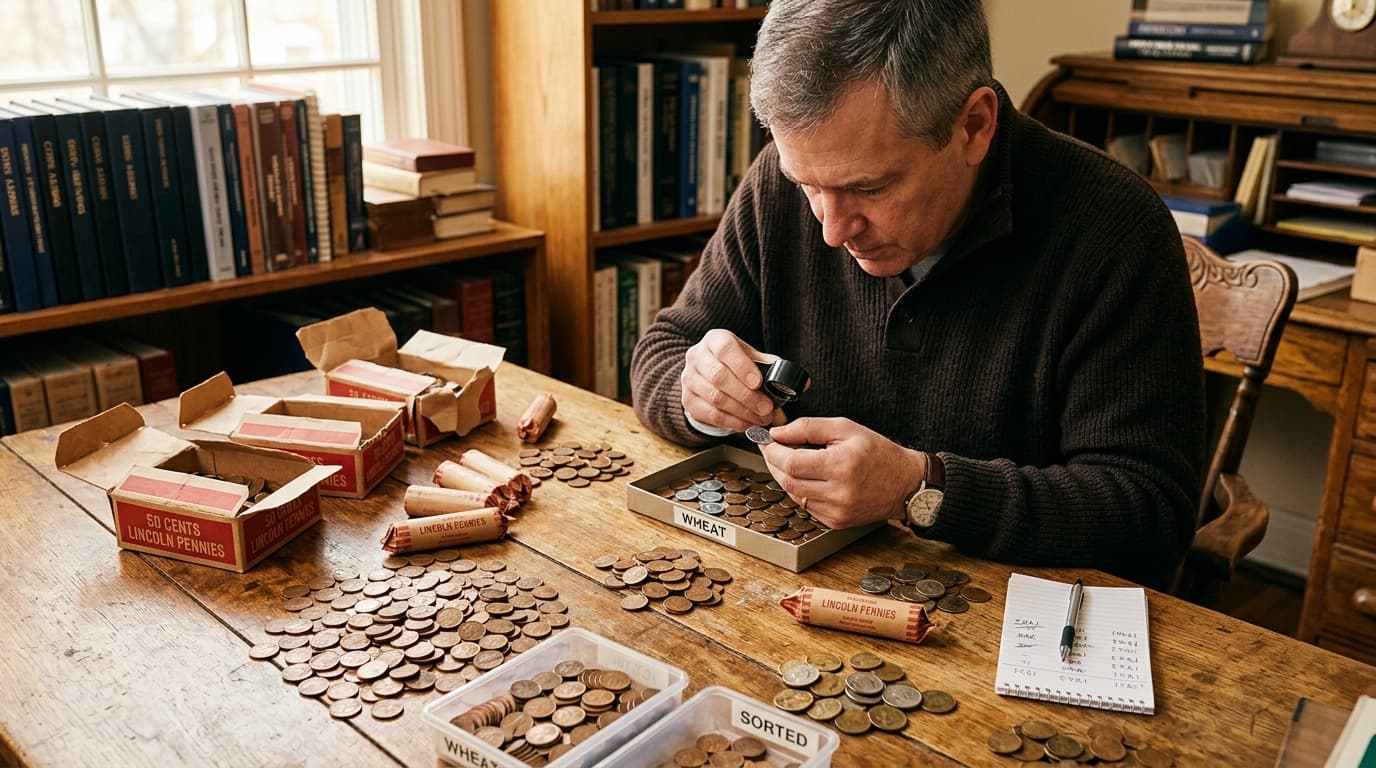
1960s Roll Searches Shape Silver Coin Market Prices
Roll-searchers—a numismatics community spanning since the 1960s—discover rare dates and mint marks in bank rolls of Silver Dimes and Quarters, then post detailed findings with statistics. These community datasets dynamically reshape market rarity assessments and adjust certified coin prices in real time, functioning as a pricing mechanism parallel to professional grading services.
Roll searching has evolved from a niche hobby into a sophisticated and scientifically-structured collecting activity that commands significant attention within the numismatic community worldwide. The practice of systematically examining bank rolls of circulating coins in search of rare dates, mint marks, error coins, and other numismatic treasures has established itself as both an economically viable pursuit and a meaningful educational endeavor. This hands-on methodology has democratized rare coin acquisition, allowing collectors of modest means to potentially discover valuable pieces without substantial financial investment.
The historical origins of roll searching can be traced to the 1960s, when pioneering collectors made the groundbreaking discovery that circulation coins contained numerous valuable specimens of key dates and rare mint mark combinations. This realization fundamentally transformed the numismatic landscape, shifting focus from exclusive high-end acquisitions to inclusive community-based discovery. Over subsequent decades, roll searching matured into a systematic science, complete with documented methodologies, statistical tracking, and sophisticated market analysis integrated into the broader collecting community.
Online platforms such as a numismatic forum have become indispensable infrastructure for the roll-searching community, functioning as central repositories for collective knowledge and experience. These digital gathering spaces enable collectors across geographic boundaries to collaborate, share detailed photographic evidence, discuss findings, and collectively contribute to an expanding database of circulation rarity data. The networked nature of these communities has created unprecedented transparency in documenting which dates, mint marks, and varieties appear in contemporary circulation, allowing researchers to construct empirical models of modern coin distribution patterns.
The content shared within these communities exhibits considerable sophistication and detail. Collectors routinely post high-resolution photographs, comprehensive statistical analyses including precise roll counts and discovery rates, detailed condition assessments using standardized grading terminology, and contextual historical analysis connecting specific coins to broader numismatic narratives. Such detailed reporting enables other collectors to identify productive search strategies, understand distribution anomalies, and recognize exceptional finds that may warrant premium valuations in the current market.
From a market perspective, roll searching has increasingly attracted attention as a value-discovery mechanism within the broader rare coin market. Circulating coins identified through systematic roll searching often command premium prices relative to non-circulated specimens of identical dates and mint marks, reflecting both rarity documentation and provenance verification through community reporting. The transparent information sharing within roll-searching communities contributes to price discovery mechanisms, as market participants can evaluate relative scarcity based on empirical abundance data derived from thousands of documented searches conducted across diverse geographic regions.
The epistemological value of collective roll-searching data extends beyond immediate monetary considerations. The aggregated results from numerous searchers create a statistical foundation for understanding modern mintage policies, identifying printing errors and mint irregularities, and documenting the actual composition of coins in active circulation. This data proves invaluable to numismatic researchers, academic institutions, and the United States Mint itself, as it provides empirical evidence regarding coin distribution, degradation rates, and production anomalies that would otherwise remain undocumented.
The cultural and educational dimensions of roll searching merit substantial recognition. By engaging with circulating coins as historical artifacts rather than mere monetary instruments, participants develop deeper appreciation for numismatic history, metallurgical composition, and the evolutionary development of American coinage systems. For younger collectors particularly, roll searching serves as an accessible gateway to serious numismatic study, frequently motivating progression toward advanced collecting specializations including die varieties, mint errors, and historical research.
Technological advancement has substantially enhanced roll-searching capabilities in recent years. Improvements in magnification optics, specialized lighting equipment, and digital photography now enable collectors to document minute details with unprecedented precision, revealing die cracks, doubled dies, and other diagnostic characteristics previously requiring museum-grade examination equipment. The rapid dissemination of these technological innovations through online communities has democratized expertise, enabling individual collectors to achieve semi-professional evaluation standards.
The future trajectory of roll searching appears positioned for continued evolution and increased significance within numismatic culture. As circulating coin volumes decline in an increasingly cashless economy, discoveries within remaining circulation pools will correspondingly increase in relative rarity and value. Simultaneously, emerging technologies including artificial intelligence image analysis and blockchain-based collection documentation may revolutionize how searches are conducted, verified, and monetized, potentially creating entirely new market opportunities within the collecting ecosystem.
The psychological and community-building dimensions of result sharing cannot be overlooked in understanding roll-searching culture. Public recognition of discoveries, community validation of findings, and collaborative problem-solving around identification and valuation create powerful social reinforcement mechanisms that sustain engagement and attract new participants. This positive feedback loop strengthens community cohesion while simultaneously expanding the collective knowledge base and analytical capacity of the broader numismatic community.
Participation in roll-searching result-sharing represents far more than casual data contribution. It embodies a commitment to advancing collective numismatic knowledge, enhancing market transparency, documenting monetary history, and fostering educational engagement with material culture. By systematically documenting and publicly sharing discoveries, individual searchers contribute to an expanding archive of empirical data that serves scholars, collectors, and researchers worldwide. The tradition of transparent information sharing stands as a cornerstone principle distinguishing roll-searching communities as genuinely collaborative intellectual enterprises rather than competitive commercial endeavors.
Related Articles
Weekly Market Intelligence
Weekly rare coin intelligence — auctions, price action, and analysis, delivered via LINE.
Free · Instant · Block anytime