Heritage's January 14-17, 2026 FUN Numismatic Auctions Realize $63,386,877
CoinNews reported on January 21, 2026, that Heritage Auctions' FUN numismatic auctions held January 14-17, 2026, realized a combined $63,386,877. The top lot was an 1804 Class III Draped Bust Dollar, PR58 PCGS, from The Presidio Collection at $3,538,000, and numerous auction records were set.
Correction (Oct 13, 2026): We rewrote the headline, summary and body to match the source. We removed unsupported statements, including a survival estimate of about 15 coins, a description of BB-306 as a classification by "Bernard Beverly Douglas," claims that metal prices and international investors drove the price, and statements about market maturity, diversification and inflation hedging, and stated the known population (16), the breakdown of the total and other key results as the source gives them. The previous headline was "$3.538M 1804 Draped Bust Dollar: How Rarity Premium Dominates Modern Numismatic Valuations."
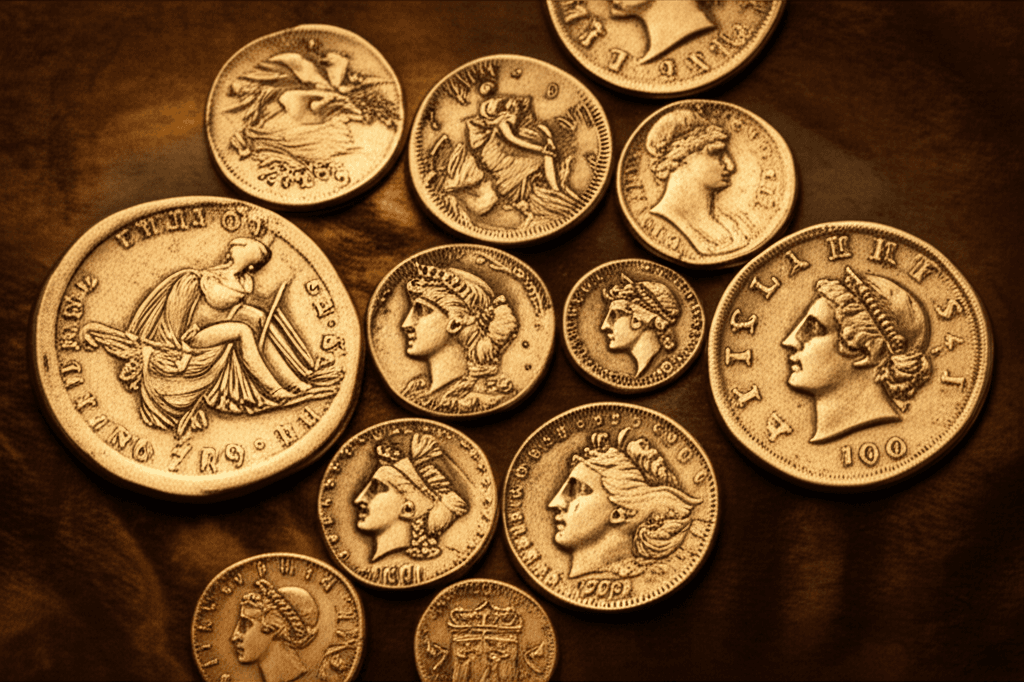
CoinNews reported on January 21, 2026, that Heritage Auctions' FUN numismatic auctions held January 14-17, 2026, realized a combined $63,386,877.
How the total breaks down
The FUN US Coins Signature Auction realized $54,272,176. That figure includes the $7,174,036 FUN Special Sessions: Ellsworth & Jacobson. Adding the $9,114,701 FUN U.S. Currency Signature Auction brought the combined total to $63,386,877.
An 1804 dollar led the sale
The top lot was an 1804 Class III Draped Bust Dollar, PR58 PCGS, BB-306, from The Presidio Collection, which sold for $3,538,000.
According to CoinNews, this Adams-Carter specimen is one of 16 known examples of the 1804 silver dollar, one of seven Class III examples and one of four Class III coins not housed in a museum collection.
Todd Imhof, Executive Vice President of Heritage Auctions, said the result was "a significant jump since its last appearance at Heritage in 2009, when it sold for $2.3 million."
The report says Heritage will offer Part II of The Presidio Collection in its CSNS Auction April 29-May 3.
Stellas and an 1829 half eagle
An 1880 Coiled Hair Stella, PR67 Cameo NGC, from The Costa Family Collection, Part II, sold for $2,074,000. The report describes it as arguably the finest of only nine graded examples, and says questions remain about why it was made, when it was struck and for whom, and how many examples were produced.
An 1879 Coiled Hair Stella, PR66 Cameo PCGS, from the same collection sold for an auction-record $1,464,000, just above the previous record of $1,440,000 set at Heritage in August 2025. It is one of 13 confirmed examples.
An 1829 Capped Head Left Half Eagle, MS66 NGC, sold for $1,006,500, an auction record for a circulation strike 1829 Large Diameter Large Date BD-1 half eagle. The previous record of $763,750 had stood for nine years.
Other auction records
The report lists many other auction records, including:
- 1867 Liberty Double Eagle, PR66 Ultra Cameo NGC: $793,000 (previous record $660,000, set in December 2025) - 1854-S Liberty Quarter Eagle, XF45 PCGS CAC, from the Presidio Collection: $561,200 (previous record $408,000, set in 2024) - 1803 BD-3 Eagle, MS64+ PCGS CACG: $231,800, a record for an 1803 Small Reverse Stars eagle (previous mark $161,000, standing since 1999) - 1864-S Liberty Eagle, AU55 NGC: $219,600 - 1909-S VDB Lincoln Cent, MS67 Red PCGS: $170,800 - 1835 B-2 Quarter, MS66 PCGS CAC: $134,200 - 1869 Three Dollar, PR66 Deep Cameo PCGS: $134,200 - 1944-D Steel Cent, MS62 PCGS CAC: $122,000, after 74 bids - 1919-D Walking Liberty Half Dollar, MS64+ PCGS CAC: $79,300, a record for an example in that grade
Ellsworth & Jacobson session
This session was led by two coins from the Harvey B. Jacobson, Jr. Collection of Early Half Eagles, a 1797 BD-4 Half Eagle, AU58+ PCGS, and an 1834 BD-4 Half Eagle, MS64+ PCGS CAC, each of which sold for $268,400.
An 1828 BD-3 Half Eagle, MS61 PCGS, sold for an auction-record $256,200. It is one of two confirmed pieces; the other is in the Smithsonian.
From the COL Steven Ellsworth Collection of U.S. Large Cents 1793-1796, a 1793 S-15 Liberty Cap Cent, VG8 PCGS, sold for $134,200 and a 1794 S-53 Cent, AU50 PCGS, sold for $109,800.
Currency
The top note in the currency auction was a Fr. 2231-A $10,000 1934 Federal Reserve Note, PMG Choice Uncirculated 63, which sold for $317,200. According to CoinNews, it is a new addition to the Track & Price Census that raised the known population to 18 examples.
A Fr. 2220-F $5,000 1928 Federal Reserve Note (Atlanta) sold for $244,000, and a Fr. 2231-F $10,000 1934 Federal Reserve Note, PMG Very Fine 30, one of two known 1934 Atlanta $10,000 notes, sold for $183,000.
A Laramie City, Wyoming Territory $5 1875 Fr. 402 national bank note sold for $164,700, the most ever paid for any Wyoming national bank note.
Dustin Johnston, Senior Vice President of Numismatics at Heritage Auctions, said ultra-high-denomination notes "are coveted by the most serious of collectors."
Source: CoinNews, "Heritage Jan. 14-17 FUN Numismatic Auctions Top $63.38M" (January 21, 2026).
Read next
Weekly Market Intelligence
Weekly rare coin intelligence — auctions, price action, and analysis, delivered via LINE.
Free · Instant · Block anytime