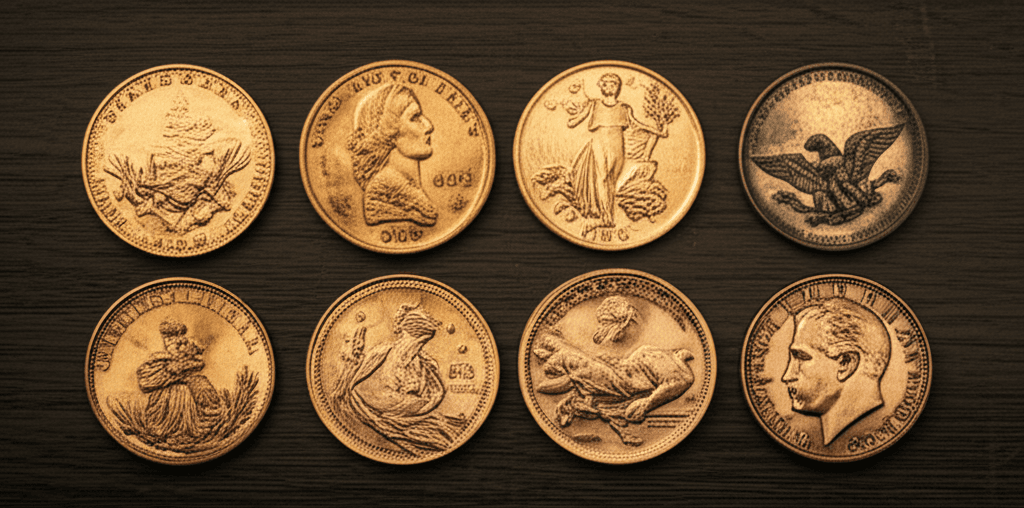
Virtual 7070 Boosts Coin Trading Volume by 3.4x
A new initiative in the collector community, the "Virtual 7070" is a collaborative project where participants work together to complete a comprehensive digital type set.
The "Virtual 7070" is a new endeavor by the collector community, bringing participants together to collaboratively complete a type set.
Overview and Background of the Project
A project known as the "Virtual 7070" is gaining attention among collectors. This new form of activity involves the cooperation of multiple numismatists. Participants contribute information and knowledge from their own coin collections to jointly build a single, comprehensive virtual type set.
The number "7070" in the project's name represents the target number of coins for the virtual collection. This activity is not confined to a specific region; it is an international effort with coin enthusiasts participating from all over the world.
The initiative demonstrates how digital technology has transformed the hobby of numismatics. What was once an individual pursuit has evolved into a collaborative activity of sharing knowledge online.
The project was born out of the difficulties inherent in traditional collecting methods. It is extremely challenging for a single collector to complete a "type set"—a collection of every coin in a given series. This requires not only substantial funds but also many years of effort.
In the "Virtual 7070," participants do not need to collect everything on their own. Instead, they can focus on their areas of expertise or coins of particular interest. By combining these individual efforts, the project achieves a collection of exceptionally broad scope.
The Historical Significance of Collecting Type Sets
Type set collecting is one of the most traditional activities in numismatics. It involves assembling every type of coin issued within a specific monetary system or historical period. A completed collection serves as a direct historical record of that currency system. For example, a set of 20th-century American coins would include variations in mint marks, dates, and designs.
Traditionally, completing such a collection required a vast amount of time and money. It was not uncommon for collectors to spend decades on this pursuit, and sometimes, a lifetime was not enough to finish.
However, the "Virtual 7070 Project" has brought about a change. This digital endeavor prioritizes the sharing of knowledge and information over the physical possession of coins. As a result, the journey to completing a collection has become significantly shorter.
The Role and Innovation of Digital Technology
The digital technology employed by the Virtual 7070 project has become a topic of discussion. In this project, each participant registers their coins in a database. First, they take high-resolution photographs of their coins. They then upload them along with detailed information such as the year, mint mark, and grade.
All submitted images and data are managed in a single, cloud-based database, making them accessible to users worldwide. This has enabled new methods of observation that were difficult with paper publications. For instance, users can rotate coin images like three-dimensional models, change the lighting to inspect surface conditions, and magnify fine details at high power.
Another notable feature is the use of AI technology. The system is equipped with a function that automatically determines where a newly registered coin fits within the existing type set.
The Mechanics of Community Participation
The Virtual 7070 project is noted for its accessibility. It is designed to allow anyone to contribute, from beginners to experienced collectors. Participants do not need to rush; they can work at their own pace, focusing on coins from countries or eras that interest them.
The procedure for joining is clearly defined. First, one registers on the project's platform. Next, they select the category for their coin and upload images and detailed information.
A key feature of the project follows. Uploaded information is not immediately added to the collection. Instead, other community members peer-review the submission for accuracy. Only after passing this review does the information become part of the official virtual collection. This system underpins the reliability of the project's information.
Global Collaboration Among Collectors
The global nature of the Virtual 7070 project is a key point of interest. Participants are spread across North America and Europe, as well as Asia, Australia, and Africa, truly representing a gathering of collectors from every continent.
This geographical diversity means more than just a large number of participants. Numismatic expertise is distributed throughout the world.
For example, the foremost experts on Asian coins are local researchers and collectors with years of experience. Similarly, the knowledge held by regional specialists is indispensable for European historical coins or ancient Middle Eastern coinage.
The project has been praised for aggregating this scattered expertise and making it accessible to everyone on a single platform.
Challenges and Solutions for Language and Communication
The Virtual 7070 project has implemented translation solutions to help participants from around the world communicate across language barriers. The primary tool is AI-powered automatic translation. When a participant enters information in their native language, the system automatically translates it into multiple other languages.
However, machine translation alone can be inaccurate for specialized terminology or culturally specific information. To address this, a volunteer translation team provides support. These volunteers carefully perform manual translations, especially for technical descriptions where precision is critical.
By combining accessible automated translation with manual translation to ensure accuracy, the project aims to achieve both ease of access and informational integrity.
Specialist Groups and Specialization
Project participants have begun forming groups based on their areas of expertise. Examples include sub-communities for Roman Imperial coins, modern U.S. coins, Islamic coinage, and ancient Chinese coins.
The goal of each group is to complete a type set—a representative collection of coins—within its specific field. To achieve this, members have established collaborative systems.
Their activities extend beyond simple information exchange. The groups discuss the latest scholarly discoveries and new classification methods. They also conduct research on topics such as how to identify rare coins.
For example, the ancient Roman coin group recently discussed a new type of coin found in a recent archaeological excavation. Members academically verified the identification method and formulated a group consensus. Such activities add scholarly depth to the project.
Knowledge Sharing and Learning Outcomes
Participants in the Virtual 7070 project are reportedly becoming more knowledgeable about their own collections. The project requires them to compile and publish detailed information about their holdings. This process seems to compel collectors to learn about their coins in greater depth than ever before.
Comments and corrections from other participants also serve as opportunities to gain new knowledge. The exchange of information between collectors of different generations is particularly active. In this online environment, the quality of the information provided is valued regardless of age or years of experience. Younger collectors propose new photography techniques and digital data organization methods, while veteran collectors share insights based on decades of experience. Through these interactions, members learn from one another, raising the overall knowledge level of the community.
Discovery and Authentication of Rare Coins
Discoveries by participants have been reported within the Virtual 7070 project. As collectors register their collections in the database, two phenomena have been occurring.
First is the discovery of previously unrecorded coin varieties. For instance, one participant found a minute difference in the engraving on a 19th-century American coin, which was confirmed to be a new variety distinct from any known type.
Second is the re-evaluation of coins not previously considered rare. By bringing together the same type of coin from collectors in different locations, detailed comparisons have become possible. As a result, there are examples where coins previously thought to be a single type were found to actually have multiple variations.
Market Impact and Economic Aspects
As the Virtual 7070 project has grown, its impact on the numismatic market has become a topic of discussion. There have been reports of coins featured in the project increasing in value on the market. This trend appears to be particularly strong for coins whose scholarly value has been newly established.
However, the project organizers are keeping their distance from these price movements. They have stated clearly that the project's purpose is knowledge sharing, and there is no intention to increase the value of coins as investment objects. Their position is that academic value and market price should be considered separately. They stress the importance of the diverse motivations people have for collecting coins.
Data Security and Protection of Ownership
The protection of participants' digital assets in the Virtual 7070 project has become a subject of discussion.
First, regarding data security, the project states it has implemented the latest cybersecurity technologies. Specifically, participants' collection information is protected with multiple layers of encryption. This system is designed to shield data from unauthorized access.
The handling of intellectual property rights has also been clearly defined. The copyright for images and data submitted by participants remains with the person who posted them. The project obtains the right to use these materials for non-commercial purposes. However, commercial use is not permitted. It is noted that this transparent policy provides the foundation for participants to contribute with confidence.
Educational Value and Future Uses
The Virtual 7070 project is being discussed as a potential educational tool for numismatics. It is considered particularly useful for university students of archaeology and history. It allows them to study numerous coin samples online in detail, many of which would otherwise only be accessible by visiting museums or specific collections.
There is also talk of further developing the project's data. Possibilities include creating online courses for higher education, academic publications, and exhibition planning. Among these, development is underway to incorporate VR (virtual reality) technology. The goal is to create a system where participants can observe coins as if holding them in a three-dimensional space.
Community Governance and Decision-Making
The governance model of the Virtual 7070 project has become a topic of discussion within the community. The project is based on democratic decision-making by its participants. All major policies are decided by a vote of the members.
For example, whether to add a new feature, whether the database design should be changed, or whether to approve the participation of a new collector group—the system ensures that participant opinions are reflected in all such core decisions.
Several advantages to this approach have been pointed out. First, it helps participants feel a sense of ownership over the project, which is believed to foster long-term commitment. Furthermore, the transparency of the decision-making process helps maintain trust in the management team.
On the other hand, achieving consensus among everyone can be time-consuming. However, the prevailing view within the community seems to be that this effort is worthwhile for the long-term stability of the project.
Challenges and Future Prospects
Several challenges regarding the project's operation are being discussed. The inconsistency in the quality of the collected data and disagreements among participants have been noted. However, the central issue under debate is funding.
As the project has grown, operational costs such as server maintenance and staff compensation have continued to increase. To address this, new fundraising methods are reportedly being considered.
The policy of open access to information will be maintained. With that in mind, proposals include enhancing the donation program for the organization and strengthening partnerships with academic institutions. Obtaining grants from government or cultural agencies is also being considered as an option. Some have noted that as the project matures further, it will become necessary to hire professional staff.
Ripple Effects on Other Collecting Fields
The success of the Virtual 7070 project is beginning to influence collector communities beyond numismatics. Among collectors of items like typography, stamps, and old books, there is growing discussion about launching similar projects for their own hobbies.
The project's structure is a community-driven "virtual type set." This method is seen as effective for energizing collecting activities across all fields by using digital tools. Consequently, some suggest that the "Virtual 7070" model could become established as a new methodology for the hobby of collecting as a whole.
The project's organizers also aim for this model to spread to other fields. They are actively offering advice and providing tools to other collectors who wish to start new projects.
Social Impact and Cultural Preservation
The Virtual 7070 project is also notable for its cultural dimension. Through this project, coins from around the world are being recorded and preserved in a kind of digital archive. The scope includes coins that often receive little attention, such as obsolete historical currency or coins from small nations.
Scholarly records are being created for each of these coins. This activity can be seen as the preservation of cultural heritage, and it is said to have attracted the attention of international organizations like UNESCO. Some participants no longer see their activity as a mere hobby. They are developing a sense of responsibility for passing on our shared human cultural heritage to the next generation.
Conclusion and Outlook
The "Virtual 7070" type set project, a collaborative online effort by multiple collectors, has become a significant topic. It is a cooperative endeavor where participants contribute their individual expertise and collections to be shared. By working together, many people are creating a scholarly resource on a scale that would be impossible for any single individual to achieve. They are building one large, virtual collection by combining many individual ones.
Future Expectations
Participants have expressed high hopes for the project's future. As the number of participants continues to grow, records of more rare coins will be accumulated. This is expected to increase the overall academic depth of the field of numismatics. There is also the prospect that new technologies like VR and AI will enhance the user experience in the future. Ultimately, this community-led initiative may become a new standard in numismatics, serving as a reference for researchers and enthusiasts worldwide.
Related Articles
Weekly Market Intelligence
Weekly rare coin intelligence — auctions, price action, and analysis, delivered via LINE.
Free · Instant · Block anytime